Hidden · McCarthy, Alaska, United States
Kennecott
A red mill town beside the Kennicott Glacier that shipped copper to the coast for nearly thirty years, then emptied out when the last train left in 1938.
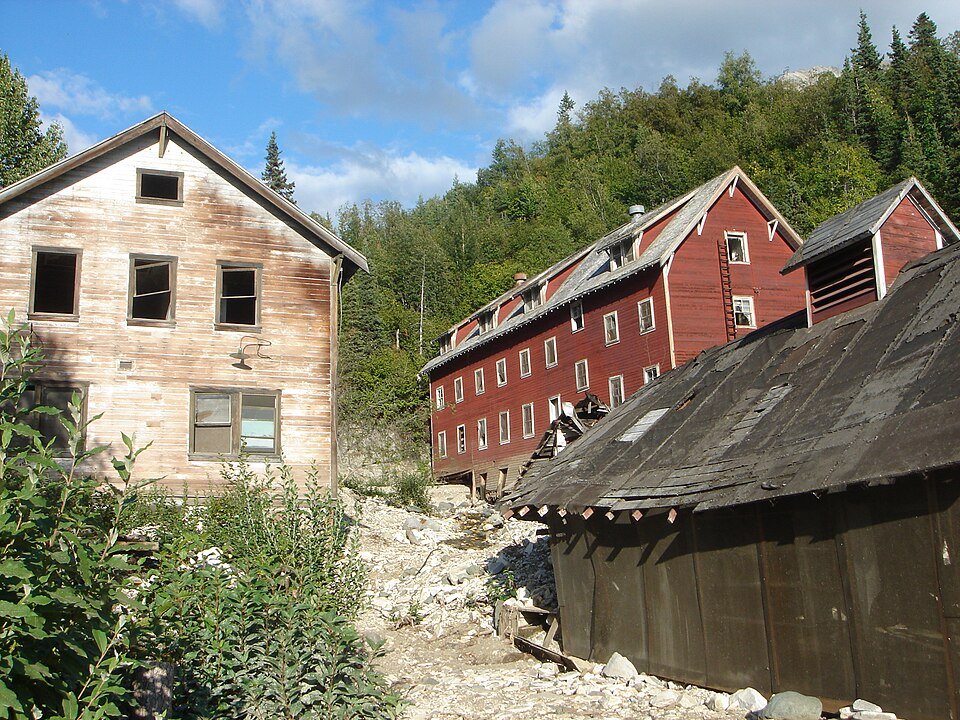
A fourteen-story mill beside a glacier.
Kennecott is an abandoned mining camp inside Wrangell-St. Elias National Park and Preserve, beside the Kennicott Glacier in Alaska. It was the center of activity for several copper mines, and the camp and mines are now a National Historic Landmark District run by the National Park Service. It was designated in 1986, and the National Park Service acquired much of the land in the mill town in 1998.
The centerpiece is the concentration mill, a 14-story building put up mainly between 1909 and 1923. Ore reached it by aerial tramways and was crushed, sorted and treated step by step to get as much copper out as possible. An ammonia leaching plant was added in 1915 and a flotation plant in 1923. Five mines fed the operation: Bonanza, Jumbo, Mother Lode, Erie and Glacier, most of them linked by tunnels.
From the richest copper find to a ghost town.
In the summer of 1900, prospectors spotted a green patch high on a slope. It was malachite, and it marked the Bonanza claim. A mining engineer who went on to build the business confirmed it as the richest known concentration of copper in the world at the time. A railway to the coast at Cordova and a steamship line followed, and the first ore shipment by train left in 1911. The name Kennecott comes from the Kennicott Glacier, spelled with an "e" after a clerical error. Production peaked in 1916.
The best ore ran out by the early 1930s. The mines closed one by one, with the last three shutting in September 1938, and the final train left on November 10, 1938. Between 1909 and 1938 the mines produced over 4.6 million tons of ore containing about 1.183 billion pounds of copper. After that, only a family of watchmen stayed on, until about 1952. A late-1960s order to demolish the town was never finished, so most buildings still stand, and many are being restored.
The mill town and its relics.

Practical notes.
Before you go.
Is Kennecott a ghost town?
Yes. The last train left on November 10, 1938, and the town was never repopulated. Today the buildings stand inside Wrangell-St. Elias National Park and many are being restored.
Why is it spelled Kennecott when the glacier is Kennicott?
A clerical error replaced an "i" with an "e" when the mines were named after the Kennicott Glacier. The glacier kept the original spelling.
How do you get to Kennecott?
By air, or on the unimproved gravel McCarthy Road, which ends at the Kennicott River. A footbridge leads to McCarthy, and shuttles are available for the 4.5 miles from McCarthy to Kennecott. Check the National Park Service website for current access.
What can you do there?
Visitors tour the abandoned mill, hike on the glacier or climb ice, and take long hikes to the Bonanza, Jumbo and Erie mines. Guides are available for the harder routes.
Around Alaska
Walking tours, day trips and experiences around this area, on GetYourGuide.