Hidden · Bayard, Nebraska, United States
Chimney Rock
A clay and sandstone pillar in the North Platte valley that wagon trains steered toward on the Oregon, California and Mormon Trails, and that is shorter now than when they saw it.

A pillar that pioneers saw from a long way off.
Chimney Rock rises in Morrill County, western Nebraska, above the North Platte River valley. Its peak is 4,228 feet above sea level and it stands roughly 286 feet over the land around it. It is made mostly of Brule clay layered with volcanic ash, capped by harder Arikaree sandstone that has shielded the pillar since it separated from the cliff line to the south.
In the middle of the 19th century it was a landmark for travelers on the Oregon, California and Mormon Trails, which ran along its north side. It can still be seen from U.S. Route 26 and Nebraska Highway 92, and it appears on the Nebraska state quarter, which shows a covered wagon heading west past the rock.
From a trader's name to a National Historic Site.
The Native peoples of the area, mainly the Lakota Sioux, had their own name for the formation before European settlement. The first non-Native people to see it were probably Robert Stuart's party in 1813, traveling east from the Pacific. The name Chimney Rock probably came from early fur traders, and the first recorded use is from 1827. Other names, such as Chimney Tower and Elk's Peak, were used before it settled.
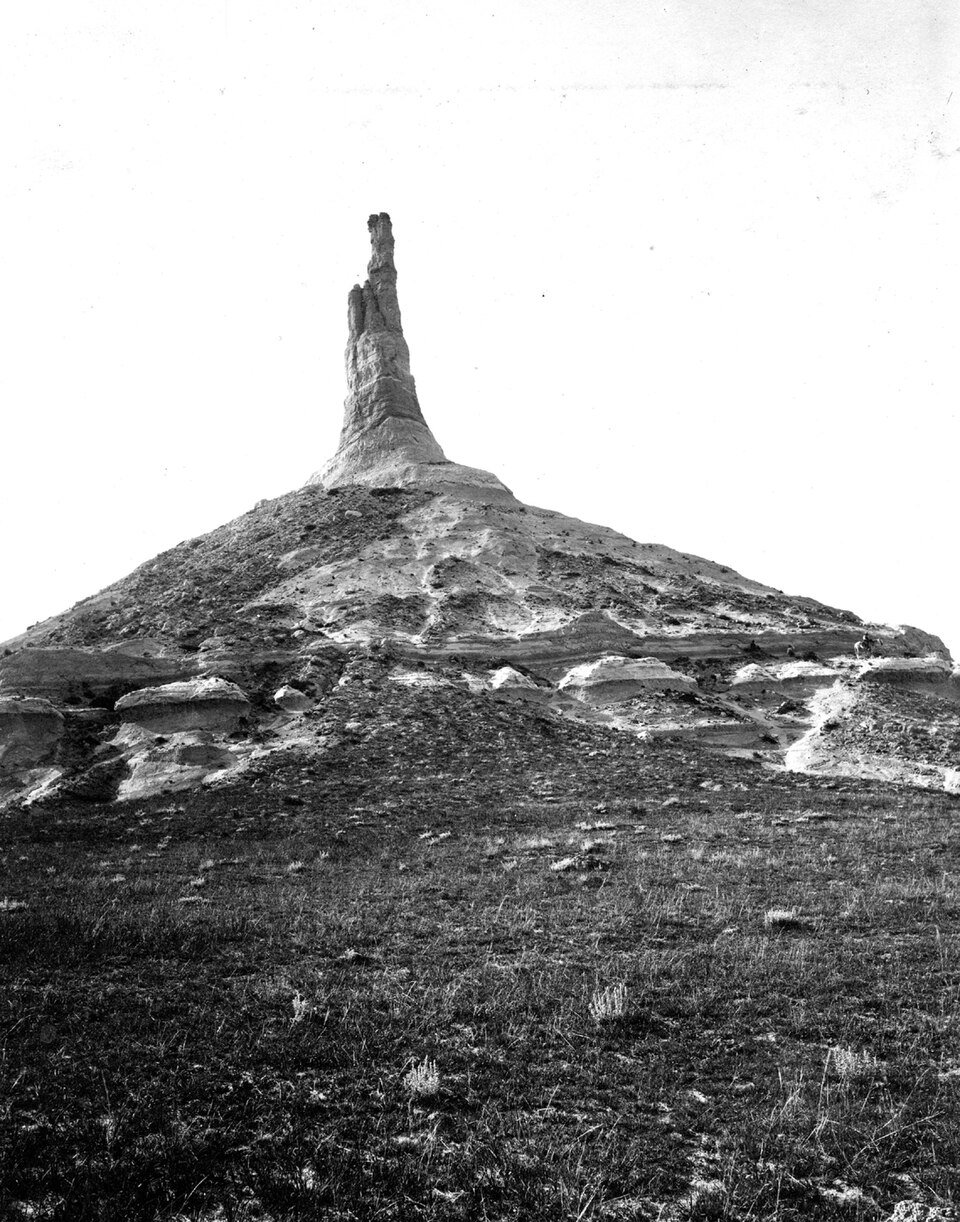
Sketches, paintings, journals and an 1897 photograph show the rock was taller when settlers first saw it. Erosion, lightning and, reportedly, cannon fire from the ground and from aircraft have lowered it. A small town called Chimney Rock once stood near its base, with a post office from 1913 to 1922. The site became a National Historic Site in 1956 and is run by History Nebraska as an affiliated area of the National Park Service. Its visitor center has museum exhibits and a video on the pioneers and western migrations.
The pillar, then and now.

Practical notes.
Before you go.
What is Chimney Rock made of?
Mostly Brule clay interlayered with volcanic ash, topped by harder Arikaree sandstone that has protected the pillar from erosion.
Why was Chimney Rock important to pioneers?
It was a landmark on the Oregon, California and Mormon Trails in the mid-19th century. The trails ran along its north side.
Has Chimney Rock gotten shorter?
Yes. Early sketches, paintings, accounts and an 1897 photograph indicate it was taller. Erosion and lightning have reduced it, and cannon fire is reported to have played a part.
Who runs Chimney Rock National Historic Site?
History Nebraska, with technical support from the National Park Service. The site was designated in 1956 and added to the National Register of Historic Places in 1966.
Around Nebraska
Walking tours, day trips and experiences around this area, on GetYourGuide.