Hidden · Watts, Los Angeles, United States
Watts Towers
A hand-built group of towers covered in broken tile, glass and shells, made over 33 years by one immigrant tile mason on his own property.
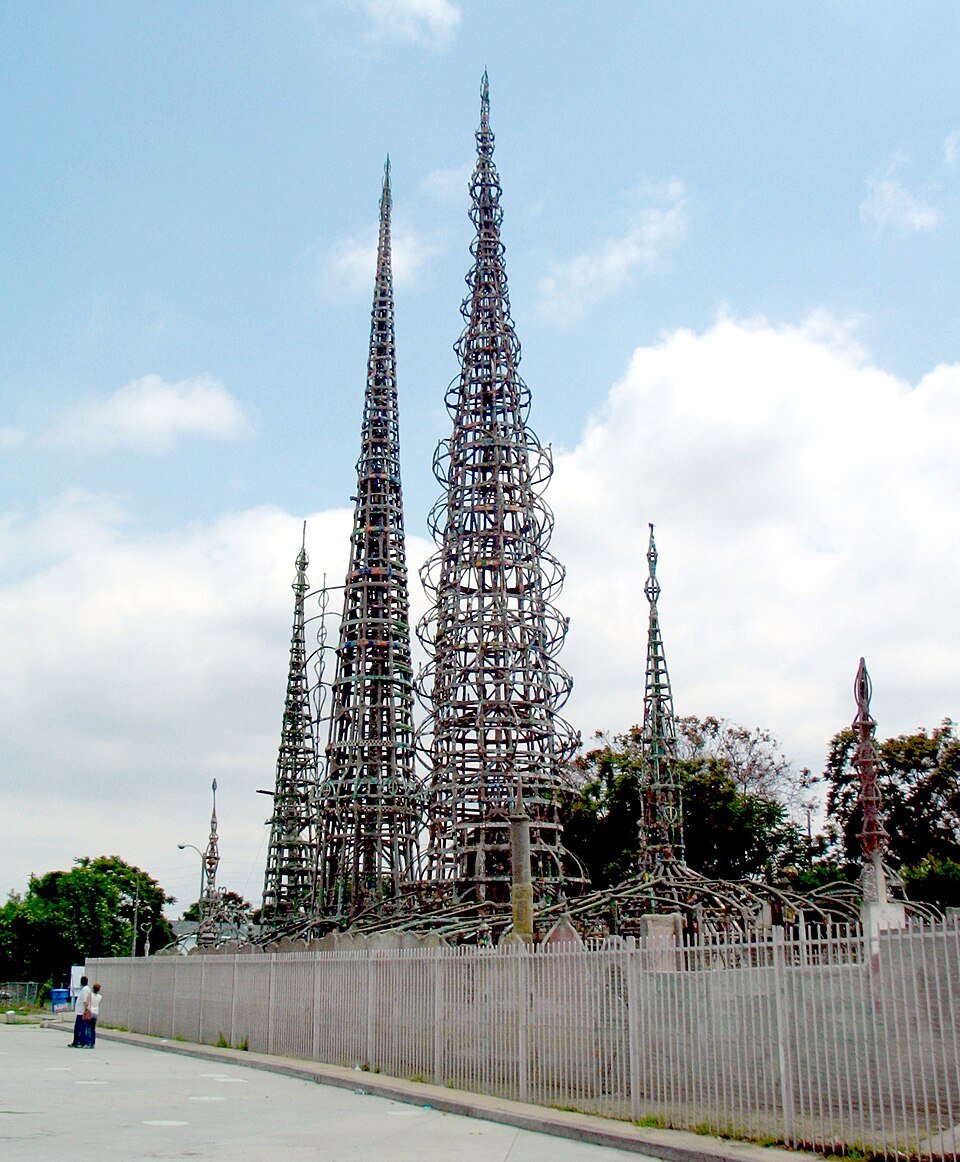
Seventeen linked structures built by one man with hand tools.
The Watts Towers are a group of 17 interconnected towers, structures, sculptures and mosaics on a property in Watts, Los Angeles. Sabato Rodia, known as Simon or Sam, an Italian immigrant construction worker and tile mason, designed and built all of it alone between 1921 and 1954. The tallest tower reaches 99.5 feet. He called the work Nuestro Pueblo, Spanish for “our town.”
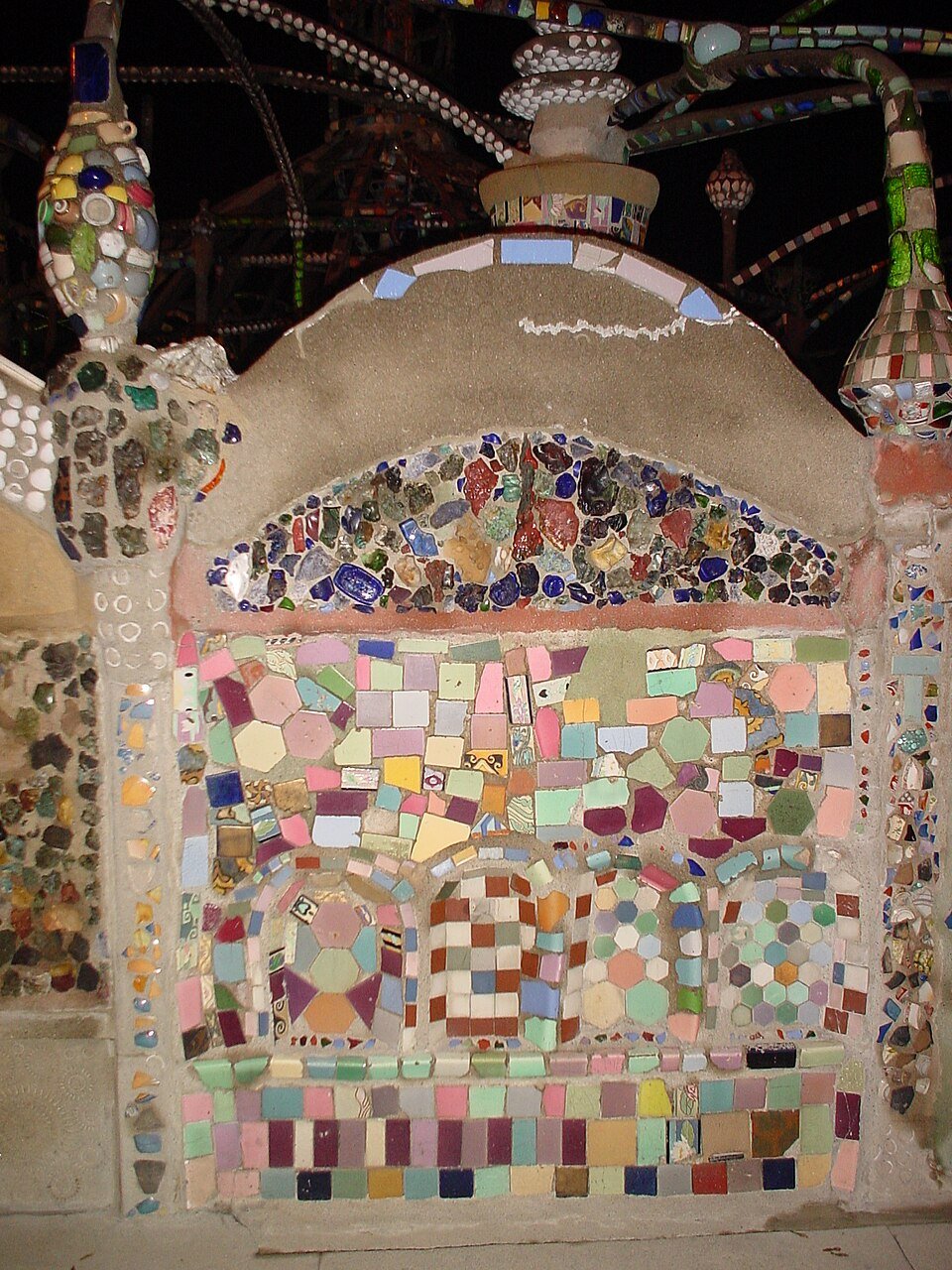
He made the frames from bent scrap steel rebar and his own mix of concrete, wrapped in wire mesh, and pressed pieces of porcelain, tile and glass into the surface. He added bottles, seashells, figurines and mirrors. He worked with hand tools and no fixed plan, and used nearby railroad tracks as a makeshift vise for bending rebar.
Neighborhood children brought him broken pottery, and he used damaged pieces from two local potteries. Some green glass still shows the logos of soft drinks from the 1930s to the 1950s, such as 7 Up and Canada Dry. He often walked the Pacific Electric Railway right-of-way toward Wilmington, close to 20 miles, looking for material. The towers strongly recall the gigli towers that feature in a yearly festival in Nola, Italy, which he was probably familiar with.
Almost demolished, then saved.
Rodia suffered a mild stroke in the summer of 1954. In 1955 he gave the property to a neighbor and left for Martinez, California, to be with his sister, reportedly tired of fighting the city over permits and of seeing the towers vandalized. He died there in 1965.
A fire destroyed his bungalow on the site in 1956, and the city condemned the structures and ordered them torn down. In 1959 an actor and a film editor bought the property to save it, and a committee of architects, artists, academics and community activists formed to defend the towers. The committee negotiated with the city for an engineering test to prove the structures were safe and avoid demolition. On October 10, 1959 the towers withstood lateral forces of up to 10,000 pounds.
The committee looked after the site until 1975, when it partnered with the City of Los Angeles, and with the State of California in 1978. The towers were designated a National Historic Landmark and a California Historical Landmark in 1990. A restoration led by the Los Angeles County Museum of Art began in 2017, and the site reopened in November 2022.
The towers and their surfaces.
Practical notes.
Before you go.
Who built the Watts Towers?
Sabato Rodia, an Italian immigrant tile mason, built them alone with hand tools between 1921 and 1954, on his own property.
What are the Watts Towers made of?
Steel rebar and a concrete mix of his own, wrapped in wire mesh and decorated with porcelain, tile, glass, bottles, seashells and mirrors.
How tall are the Watts Towers?
The tallest of the towers is 99.5 feet (30.3 meters) high.
Were the Watts Towers ever in danger?
Yes. After a fire in 1956 the city ordered the structures torn down. An engineering test in 1959 showed they were sound, and a committee of supporters saved them. A major restoration finished in 2022.
Around Los Angeles
Walking tours, day trips and experiences around this area, on GetYourGuide.