Hidden · Natchez, Mississippi, United States
Emerald Mound
A flat-topped earthen platform covering eight acres beside the Natchez Trace, the second-largest earthwork of its era in the country.
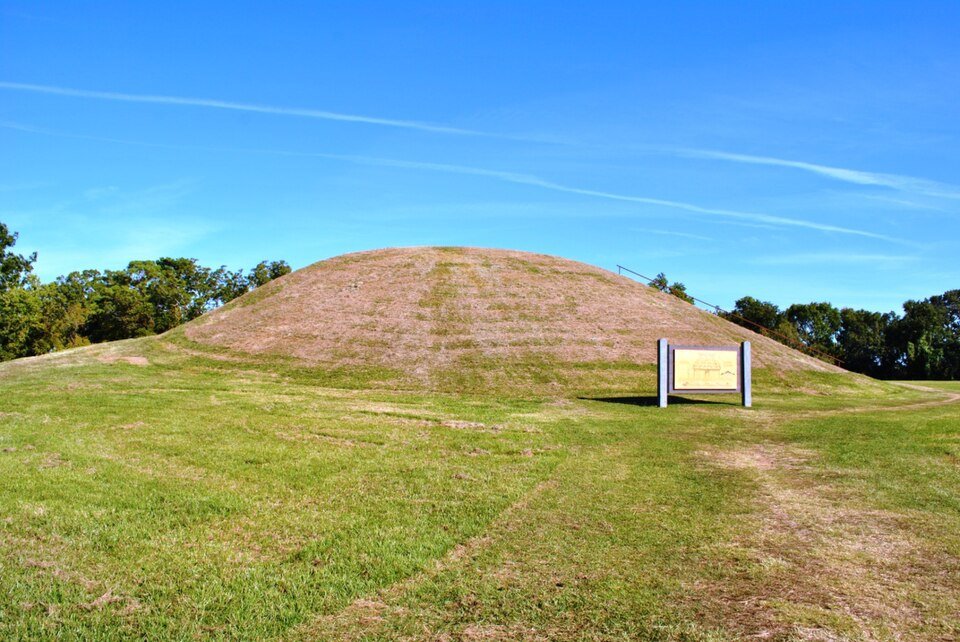
A hill reshaped into the second-largest earthwork of its era.
Emerald Mound is a Plaquemine culture archaeological site on the Natchez Trace Parkway, near Stanton, Mississippi. The platform mound covers eight acres, measures 770 by 435 feet at its base and is 35 feet high, with a summit about 65 feet above the surrounding landscape. Among earthworks of the Mississippian period in the country, only Monks Mound at Cahokia, Illinois, is larger.
It was built around a natural hill, which workers shaped by adding earth along the sides until it formed a long, five-sided artificial plateau with a flat top. Two smaller mounds sit at the ends of the summit, the larger one at the west end. They are believed to have been platforms for the homes of chiefs and other leaders.
A ceremonial center of the Natchez people.
The site dates from between 1200 and 1730 CE, and the mound was built between 1250 and 1600. People lived in outlying villages and hamlets and gathered at the center for religious and civic ceremonies. Archaeologists believe the builders were ancestors of the Natchez people, who still used it as their main ceremonial center when Europeans first arrived. By the time of the La Salle expedition in 1682, their main ceremonial center was already at the Grand Village of the Natchez, 12 miles to the southwest, and by the late 1730s they had abandoned Emerald Mound.
Early 19th-century travelers noted other mounds and a ditch around the complex that are gone now; plowing flattened six smaller mounds. The first excavations took place in 1838, and the most recent in 1972. The owners donated the site to the National Park Service in the 1950s, and the Park Service stabilized and turfed the mounds in the mid-1950s. It was declared a National Historic Landmark in 1989, is managed by the Natchez Trace Parkway and is listed on the Mississippi Mound Trail.
Practical notes.
Before you go.
How big is Emerald Mound?
It covers eight acres, measures 770 by 435 feet at its base and rises 35 feet. Only Monks Mound at Cahokia is larger among Mississippian period earthworks in the country.
Who built it?
Archaeologists believe it was built by Plaquemine culture people who were ancestors of the historic Natchez, who used it as their main ceremonial center.
What were the smaller mounds on top for?
The two secondary mounds at each end of the summit are believed to have been platforms for homes of chiefs and other leaders, and the larger one was at the west end.
Where is it?
On the Natchez Trace Parkway near Stanton, Mississippi. The Park Service manages it and it appears on the Mississippi Mound Trail.
Around Mississippi
Walking tours, day trips and experiences around this area, on GetYourGuide.