Hidden · Molokai, Hawaii, United States
Kalaupapa National Historical Park
A remote peninsula on Molokaʻi where, for more than a century, people with Hansen's disease were sent to live, now preserved as a national historical park.
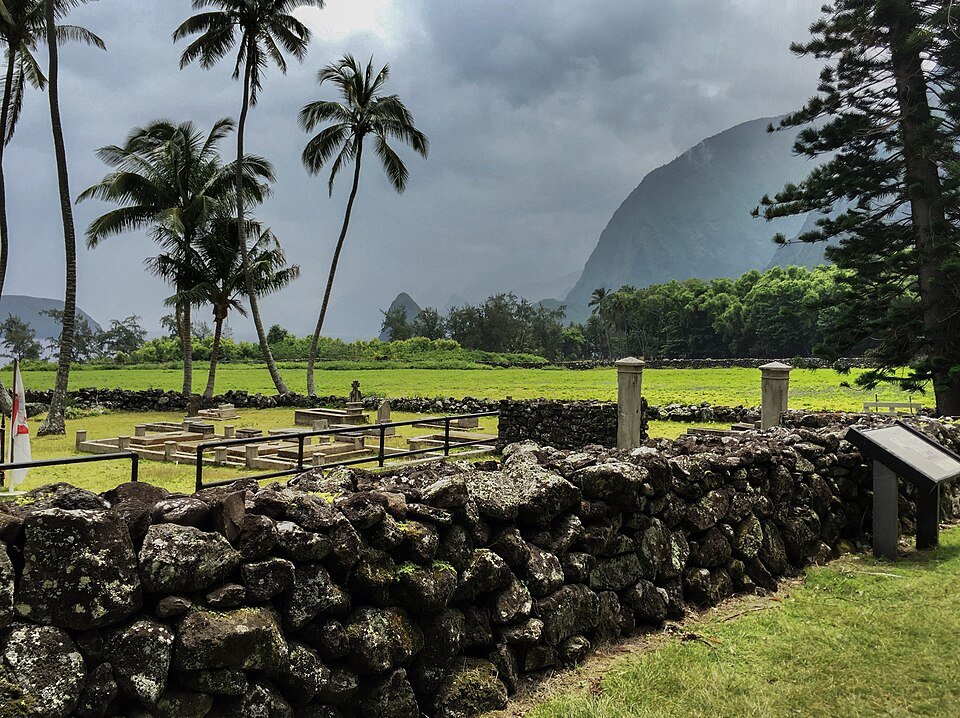
A peninsula cut off by mountains and sea.
Kalaupapa National Historical Park is on the island of Molokaʻi, Hawaii, mostly on the Kalaupapa peninsula. Congress established it in 1980, and the National Park Service administers it. It preserves the cultural and physical setting of the two settlements for people with Hansen's disease, which operated from 1866 to 1969 and were home to about 8,500 residents in total over the decades.
Long before that, the peninsula was home to Native Hawaiians. Archaeological evidence shows human habitation for more than 900 years before European contact, with house sites, taro fields, irrigation systems, stone walls and temples (heiau). Accounts from the early to mid-1800s speak of populations of 1,000 to 2,700 people on the peninsula and in the valleys, but by 1853 only about 140 remained after epidemics of diseases from Eurasia. Mountains rising 2,000 feet cut the settlement off from the rest of the island.
Isolation, loss and care.
In 1865 the Kingdom of Hawaiʻi passed a law to try to stop the spread of the disease, then incurable and much feared. Native Hawaiian residents were removed from Kalaupapa to prepare it as an isolation settlement, which cut off ties to the land that had lasted for centuries. The first settlement began at Kalawao, followed by Kalaupapa. In 1890 about 1,100 people lived there, the highest number. Patients generally had to leave their families behind on other islands, and the effects of those separations are still felt in Hawaii today.
Caregivers came to the peninsula, among them the Belgian priest Father Damien, who served from 1873 until his death in 1889, and Mother Marianne Cope, who arrived in 1888 with the Sisters of St. Francis. Both were later canonized by the Catholic Church. Hansen's disease has been curable with antibiotics since the 1940s, and there are no active cases among the people of Kalaupapa. Two historic churches stand at Kalawao: the Protestant Siloama church, founded in 1866, and Saint Philomena Catholic Church, linked to Father Damien's work.
Practical notes.
Before you go.
What is Kalaupapa?
A national historical park on Molokaʻi that preserves the settlements of Kalawao and Kalaupapa, where people with Hansen's disease were sent between 1866 and 1969.
How many people lived in the settlements?
About 8,500 residents over the decades. The population peaked in 1890 at about 1,100 people.
Is Hansen's disease still a danger there?
No. The disease has been curable since the 1940s with antibiotics, and there are no active cases among the residents of Kalaupapa or on Molokaʻi.
Can anyone visit Kalaupapa?
Access is restricted and regulated by the park. Rules and availability change, so consult the official National Park Service website.
Around Hawaii
Walking tours, day trips and experiences around this area, on GetYourGuide.