Hidden · Murfreesboro, Arkansas, United States
Crater of Diamonds State Park
A plowed field over an old volcanic pipe in Arkansas, one of the few diamond-bearing sites the public can search, with a mining history that goes back to 1906.
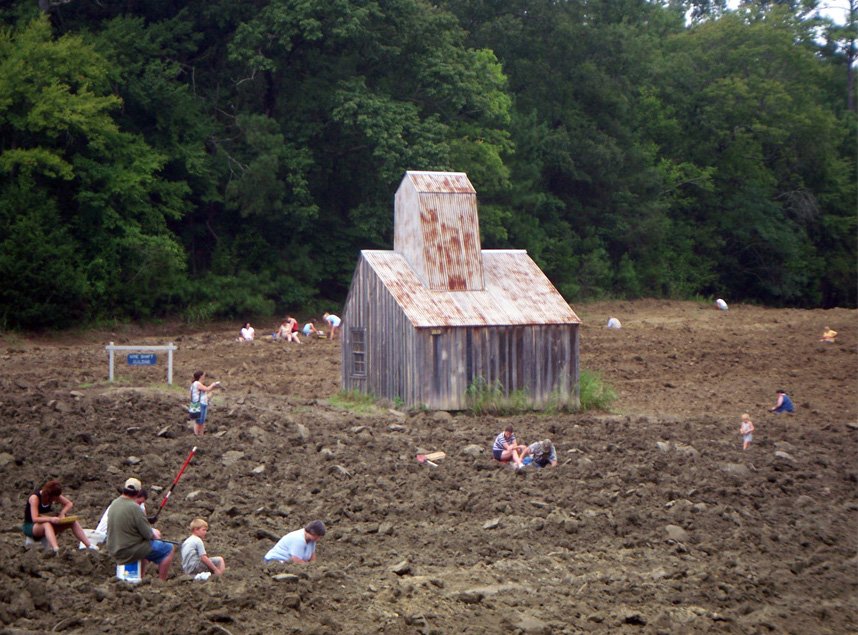
A plowed field where visitors look for diamonds.
Crater of Diamonds State Park covers 911 acres in Pike County, Arkansas, near Murfreesboro. Its main draw is a 37.5-acre plowed field, one of the few diamond-bearing sites the public can search. The park sits over an eroded lamproite volcanic pipe, and diamonds have been found in the field continuously since 1906.
Visitors can look for diamonds and other semi-precious stones such as amethyst, agate and jasper, and for about 40 other minerals, including garnet, quartz, baryte and calcite. Visitors may keep any gemstone they find, whatever its value, though rules can change. On average two diamonds are found per day, more than 600 a year, and by 2015 over 75,000 had been found in the crater.
A visitor center explains the geology of the park and has a gift shop and a cafe. The Diamond Discovery Center offers a look at how prospecting works. Around the field there are the Diamond Springs aquatic playground, an enclosed pavilion, trails and picnic areas, and the park has camping near the Little Missouri River.
From failed mines to a state park.
In 1906 John Wesley Huddleston, who had bought the land hoping to find gold, found two diamonds there in August. Geologist George Frederick Kunz, who identified them, praised the first 140 stones collected from the surface. The Arkansas Diamond Company was formed, and thousands of prospectors soon arrived. The nearby town of Kimberly grew up with stores, restaurants and a hotel.
Mining never paid off for long. The thousands of diamonds recovered were mainly under half a carat, and the few large ones were industrial grade. The mine closed in 1912 and failed again after a 1919 reorganization, and a small operation in the 1920s ended in 1932. The Uncle Sam, found in 1924, weighs 40.23 carats and is the largest diamond ever found in the United States. During World War II the Bureau of Mines dug 435 tons of material but found only 32 diamonds, and the mine closed again in 1944.
After the war the site became a tourist attraction. In 1951 The Diamond Preserve opened, and Millar's Crater of Diamonds the next year. Finds from that period include the 15.36-carat Star of Arkansas, in 1956, and the 3.11-carat Eisenhower Diamond, in 1957. In 1971 the state voted to acquire the property, and it became a state park in 1972.
Practical notes.
Before you go.
Can visitors really find diamonds?
Yes. The 37.5-acre plowed field is one of the few diamond-bearing sites open to the public. Visitors find about two diamonds a day on average.
Can you keep what you find?
Visitors may keep any gemstone they find, whatever its value. Rules can change, so check the park's current rules before your visit.
What is the Uncle Sam diamond?
A 40.23-carat diamond found in 1924. At over 40 carats, it is the largest diamond ever found in the United States.
Besides diamonds, what else can you find?
Semi-precious stones such as amethyst, agate and jasper, and about 40 other minerals, including garnet, quartz, baryte and calcite.
Around Arkansas
Walking tours, day trips and experiences around this area, on GetYourGuide.